
Into the Mangroves: Exploring Blue Carbon in Curaçao
In March 2026, one of our teams went to Curaçao to do our first GHG (GreenHouse Gas) flux and carbon stock measurements in mangroves forests. These measurements are important to get an idea of how much carbon the so called “Blue Carbon Ecosystems” are currently storing and will potentially store in the future. Mangroves forests are an important coastal ecosystem for storing carbon because the mangrove trees take up a lot of CO2 during photosynthesis. Carbon can be stored in the form of organic matter, produced by photosynthesis or captured from other sources, and accumulates in the sediments under the trees. In the sediment the organic matter can be preserved for a long time because the sediments are muddy and anoxic.
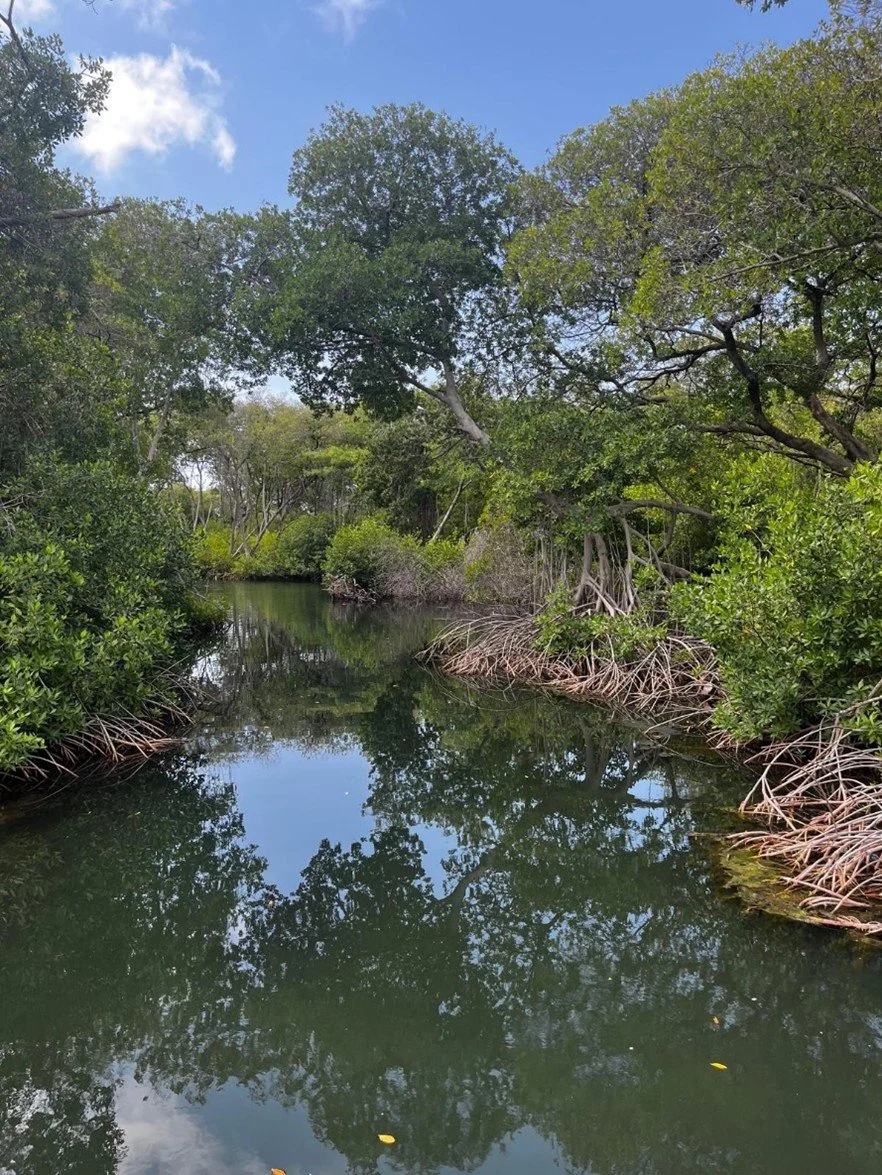
The Curaçao Rif Mangrove Park in Willemstad. Read more about the park here.
Picture by Franka ten Voorde
To measure how much carbon these mangrove forest currently store, we took sediment cores that we then sliced per centimeter. From this we can measure how much organic carbon is in de sediment and we can determine the age of the sediment. When we know this information we can determine how long it took for the carbon stocks to build up in the sediment.
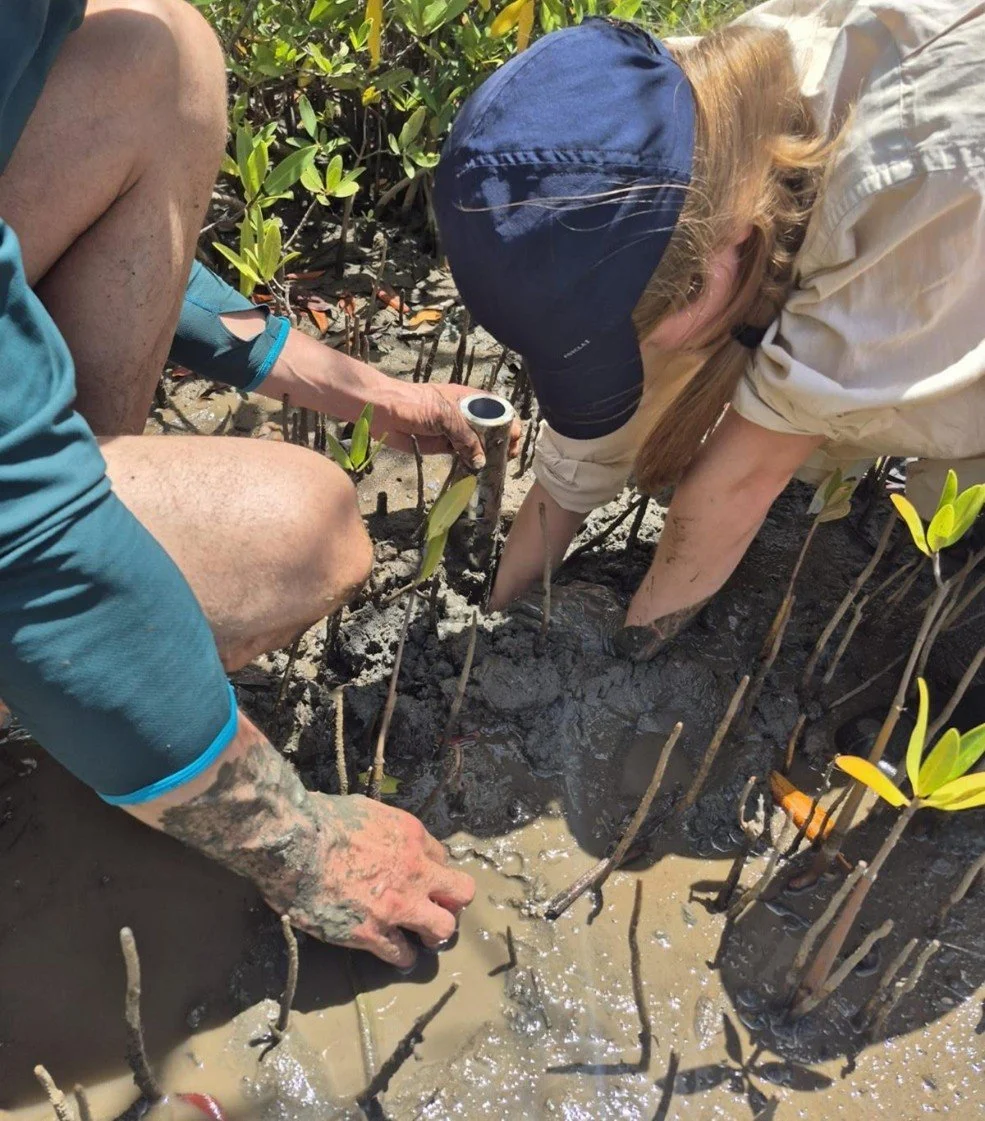
Taking out a sediment core, from the very muddy sediment. Muddy sediments usually hold more organic carbon.
Picture by Franka ten Voorde
We also measured the greenhouse gasses CO2 and methane, from the mangrove trees and surrounding sediment. We measure this using an incubation chamber that we put over a small mangrove tree and is connected to a gas analyzer instrument that we can take into the field. This way we can measure the uptake of CO2 by a mangrove tree during photosynthesis. This instrument also measures methane, a greenhouse gas that can be produced in the sediments when organic matter breaks down in an environment with low oxygen. These measurements see the effect that mangroves forests currently have on greenhouse gas fluxes.
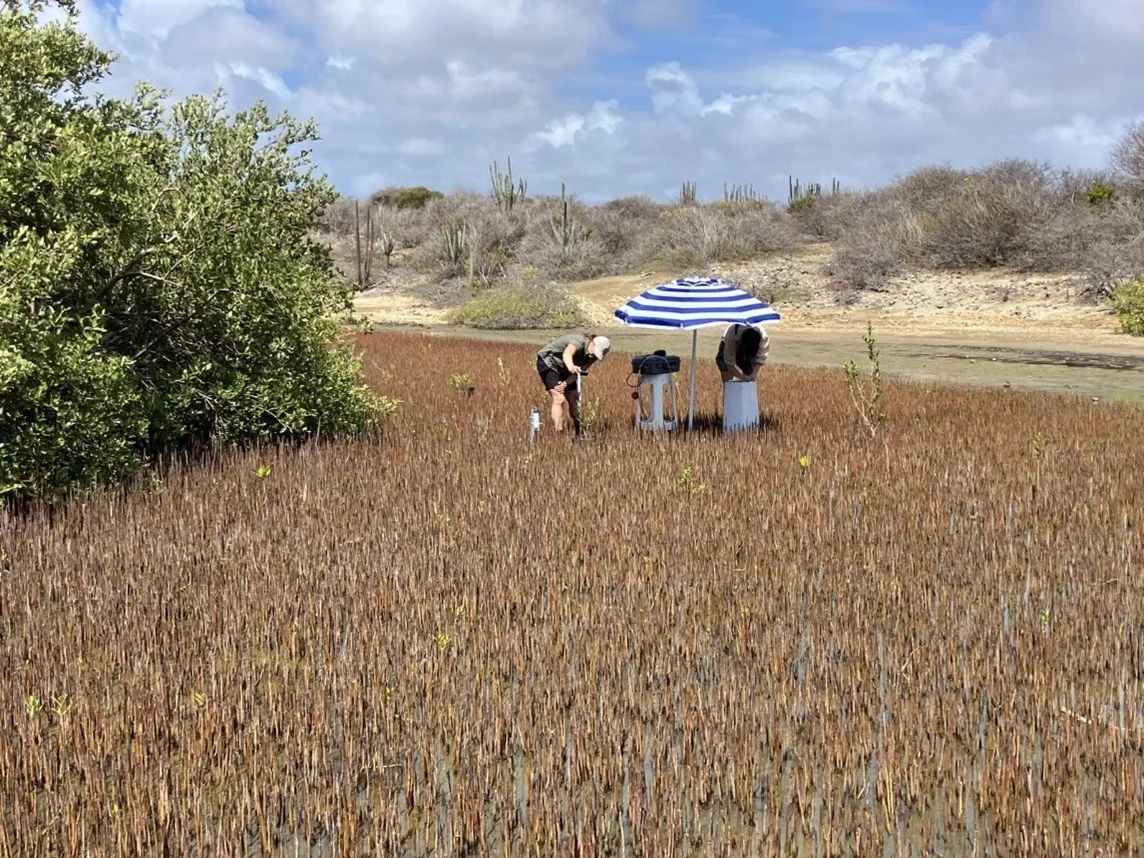
This is what our entire set up looked like. Surrounded by air roots from the mangrove trees. The umbrella is to protect our LI-COR instrument from the heat. This instrument measures methane and CO2. Picture by Franka ten Voorde.
On Curaçao we performed these measurements in three different mangrove ecosystems to see how they differ in their carbon capture capacity. Two of the locations are natural mangrove forests that have been around for a long time. One forest in an enclosed lagoon with calm waters and high salinity and one in a more exposed environment with lower salinity and more wave action. The third location is a highly managed mangrove park near Willemstad. The park is a beautiful nature reserve that serves an important educational purpose as well as supporting high biodiversity in the area (Curaçao Rif Mangrove Park). For our mission it is important to know how these parks perform in terms of carbon sequestration compared to natural systems, because they potentially play an important role in future carbon sequestration strategies to mitigate climate changes.